Thursday, May 20, 2021

What I’d say to you when you’re not around anymore


Conversations are generally two-way, but there’s the kind of conversation that can only be one-way.  It’s usually the kind of conversation uttered to the ether in faith that those words would be heard.

I’ve a particular person in mind who I know won’t be around forever.  You know who they are: your father, your mother, your sick relative, or friend.  We cannot picture what it will be like to be without them.  We can’t plan that far ahead.

Like the baby born to a new home.  All plans are made, but the reality of that baby will shatter many of those plans, bringing home the truth of the proverb, “Plans belong to a human, but the answer comes from the mouth of the Lord.”

In terms of the reality of what we’ll think, say, or do when a loved one is no longer here likewise, we may not even ponder it.  We lose sight of the irrevocable reality.

So, what would I say to that dear one—anyone close who I would grieve bitterly—when I’d already lost them?

“I’m so sorry that I didn’t get to say................................ but let me say it anyway.”

“I’m so sorry we didn’t get to do........ together.  We would have loved doing this together.  But let me do this with you in my mind right now.”

“I wish I could look into your face just one more time, to feel you physically with me, but I’m thankful for your image in my mind, and I will preserve it.”

“To hold you or hold your hand or chat or just shoot the breeze... be with me now in spirit.”

“To just be silent with you... to experience you smiling... to know you’re smiling, though, brings me peace.”

“I miss your presence so much!”

“Oh, how glorious is it up there?  I imagine you saying, ‘More incredible than you can imagine’.  But still, I just miss you.”

“There are a thousand ways that life’s different because you’re no longer here.”

“I never realised how final the concept of ‘different’ is in the grief of loss—I hate it but there is a modicum of comfort for me knowing you’re at peace.”

“I wish we could see you enjoying us.  I wish we could see your pleasure...”

“... but by faith I must hold to the idea that you watch on more immensely content at what you can see now than ever.”

“We love you so much that experiencing the little and large moments in life without you breeds pain.”

“Would you be in my tears?  Thank you that you’re part of the healing of my soul, that the pain of grief will morph into the reality that life will always be different without you.”

“I know you want me to live all my life here, and be as present for everyone as I can, but there is consolation that I will see you again.”

“In this moment, when NOBODY knows just how much I want to break down and cry right now, I cannot bear that you’re not here.”

Maybe it’s just one step closer to making the inevitable easier—to loan a vision from the future to do the present differently so there are fewer regrets when life is different and will never be the same again.

Do now what cannot be done at a time that will arrive before you know it.

Photo by Ben Blennerhassett on Unsplash

Saturday, May 15, 2021

The cycles of trauma and shame in abuse and addiction


Tragedy strikes a life for whom was written heroism, and heroism it was until trauma dug deep, the triggering started, and lamentable behaviour ensued, which then elicited that shame cycle, which further intensified the grief of trauma.

Trauma is one of the greatest undiagnosed maladies common within the sets of abuse and addiction today, and the saddest thing, trauma walked into a hero’s life unannounced, and it can threaten to stay indefinitely.

If a person is stuck in the cycle of addiction, truth is trauma probably started it.

There is so much shame attached to all these themes, and the saddest thing is shame only reinforces the vicious cycle.  If only you can get past the shame, recovery then is a distinct probability.

Abuse doesn’t always occur because a person intends to abuse.  They may hate themselves for abusing.  They may not feel entitled to abuse people at all.  They may despise the fact that they cannot help abusing substances or engage in practices that are an abuse.  So many people come to the end of their tether because they cannot get free of the bondage they’re stuck in.

Think of the nurses, the paramedics, the police, the firefighters, the veterinary surgeons and nurses, the doctors who have succumbed to work-related trauma—especially the health and other frontline workers throughout the pandemic—and, if you get close enough, you can see the social destruction trauma causes.

For getting in harm’s way for the cause of service to society.

How many upstanding citizens succumb to addictions to flee the fright of trauma as it fights to freeze the person?

How many of the people who are not affected by trauma would be if they were subjected to the same stimuli as those who have trauma?

How many of those who go on to abuse not only substances, but people go on to do so because they have unhealed trauma they couldn’t deal with?

If anything could be a legitimate scapegoat, it ought to be trauma, for it’s such an unforgiving nemesis as to stick to the walls of our bodies so we cannot escape it.

Normalising trauma is understanding how normal shame is—across the board—as the greatest protagonist of cycles of addiction, abuse, and trauma.  All these themes inherently feature much shame.

And yet, those we hail as heroes—and always ought to—come unstuck because of exposure to a hazard so immense they cannot rectify it without society’s empathy.  Yet, society is fickle—it needs its heroes, but it also cuts down the ‘villain’ with killing ferocity.

Too often the hero and the villain are the same person but for a little luck one way or misfortune the other.

The point is, let’s see the bigger picture.  Before we judge a person for glaringly poor behaviour, especially if they lament the fact, we could hold out to the possibility that there’s something that could explain it.  Judgement only makes trauma worse.  It doesn’t fix it at source.

More and more as trauma becomes increasingly attributable for maladies, we need to be a more compassionate society.  We need to be a bigger picture society that endeavours to identify causes and support people rather than not investigate the symptoms more so as to condemn and banish them.

I’m all for keeping people safe, and if trauma makes someone dangerous, then keep the targets of that aggression safe.  But it doesn’t mean we cast off the aggressor as the scapegoat banished to the wilderness.  Curiosity instead may lead us to ask them if they need help.

Those who take up the offer of help will often be helped.  We must ask and be prepared to offer it.

Addressing the problems of trauma is gathering all the symptomatic behaviours in a net, to get interested in them to the extent of doing what can be done to address the causes buried much deeper beneath.

Photo by Joshua Fuller on Unsplash


Friday, May 7, 2021

The Sacred Art of Holding Space


You see memes all about kindness costing nothing, and you wonder why more people aren’t kinder.  Well, it’s actually hard being consistently kind because it demands humility enough to shelve our righteous indignation when people tread on our toes.

Listening is the same.  There are all kinds of quotes that fly around on ‘Are you okay day?’ for instance.  It’s like society demands more people listen better, but it’s not that simple.  Listening is hard, especially when we might have something to say.

Better than listening is the practice all good counsellors use—holding space.

It’s the use of silence.  So that the person we’re with has plenty of space to think, talk a little (or much), cry, laugh, and most importantly, feel.  Of course, people who need comfort also need us to talk!  It’s discerning when, what, how long.

What people need when they want someone to listen to them is space enough to fill.  Few if any interjections, presence of curiosity and interest, the ability to focus enough to inquire into the depths and not just stay at the safer periphery.

I still ask myself why so few people hold space for others.  One of the obvious reasons is it feels so damn ineffective.  It feels like you’re doing nothing to ‘help’, but the irony is God’s Spirit helps most when there’s liminal space enough for a person to break open and pour their heart out.  Where time is no longer a dimension to interrupt the eternality of the moment.

Yes, a common reason we don’t hold space well, to be perfectly honest, is unconsciously we want some of the credit for helping the person, and yet we interrupt the precious therapy that silence and silent presence could do of its own if only we trusted the moment.

We may have faith that our words will be seasoned with just the right wisdom, but in the broken places there are no words, so the words inevitably fall short and fail.  We sell out the eternity in the moment for a pot of stew.

The Jews have this beautiful tradition of Shiva, which means ‘seven’, in that mourning would occur for seven days of sitting and stillness after the burial.  Imagine stopping life for seven whole days to mourn properly.  For many Westerners, that would be a bridge too far, too hard, too scary a prospect.

As far as holding space is concerned, adopting something of Shiva is about respecting the timelessness of grief, that lingering longer in the space means overcoming our anxiety to be in control of the moment. 

Yes, anxiety I’m reminded is a genuine interrupter.  Certainly as the liminal space in the silent moments produces discomfort and gnawing awkwardness, most of us are tempted to break that precious silence.

Sacred moments much of the time are cheapened by words and certainly too many of them or the wrong kind—advice and other things we think ‘might help’.

I think we might all be surprised just how words can interrupt healing and even traumatise people.

But doing the work of the Spirit is getting out of the way, respecting that God is already there amid the pain, doing what only God can do.

Photo by Felix Mittermeier on Unsplash

Monday, May 3, 2021

Grief explains much anxiety, depression, anger, panic attacks etc


Life is but a meandering through varying stages of loss, for we’re constantly losing, and if life is to teach us anything—about resilience I mean—it’s that we’re meant to learn how to face it, accept it, be at peace with the facts of our being that we cannot understand or change.

Whenever we face anxiety, there are components in our lives that we’d avoid.  Whether it’s a conscious known anxiety or something we just feel unknowingly anxious about, anxiety disarms confidence because we’ve either experienced a loss or we fear loss is about to occur.

Not sure what’s worse, the reality or the unshakable reality of fear.  Reality is tangible and like a living nightmare, but equally, foreboding, brooding anxiety is just as hellish.

The belief of learned helplessness in depression is the depth of grief, of loss at its unparalleled darkest. Yet, just as much, depression is instructive if we can eventually clamour our way out of those depths to new hope, and a grief-initiated depression heralds that kind of hope, ultimately.  When the pain of staying in the depression exceeds the pain needed to risk for new life, a season of rising out into the light emerges.

Patience affords us eventual success, and we add it to the wealth of our life experience.

Anger has its role in human life, yet safe expression is key.  Anger is a normal human emotion, predictive of the sadness and fear at fathoms deeper.  Add the dimension of loss and anger is explained by the injustice of grief.

There are times in grief when we have no energy, but frustratingly there’s always energy to run in fight or flight, by anger or denial.  Irritability is a worthy barometer of loss, and so is turning away from pain to the thrills of a million ways of lonely pleasure that lead to places worse than nowhere.

Panic is grief at its zenith of dread.  Seven panic attacks I had in one short season nearly eighteen years ago, and the experience of the shocking power in panic’s descent never leaves you.  Such dread is surely from the bowels of grief.  To know it, empathy is added to you.

Much of mental ill health that we face existentially is grief.  It’s the outworking of developmental trauma, resounding loss, calamitous disappointment, bewildering betrayal, shattered dreams, and every part of life that is unjust.

Yet, grief, when we see it for what it is, extends to us the invitation of facing to flourish.  Facing is resilience, and what we stand to learn is we can face our sorrow, our fear, the realities of life we find ourselves suddenly thrust into.

When we face the facets of our grief, we’re compensated through the acquisition of life experience that invigorates purpose.  None of the time wasted in grieving is a waste of time.  Every second ends up being relevant eventually.

Photo by Patrick Jansen on Unsplash

Thursday, April 29, 2021

Prayer for Bereaved Mother’s Day – May 2


Our Lord,

We are thankful for the blessings of children in our time, though we have not always appreciated this gift.  And we confess we have not always acknowledged bereaved mothers.

We are thankful that there is now a place in our calendar that acknowledges women who have suffered loss through infertility, miscarriage, stillbirth, infant death, or the loss of a child of any age.

Especially for mothers who have not been blessed with a child, at this time at least, Father, we ask that Your peace, hope and comfort would be richly felt by them in a real way for their healing and wholeness.

For mothers who have been graced with a child subsequent to loss, we praise You, our Father, for Your provision in their lives, whilst acknowledging the losses they have suffered are not diminished in any way.  That children lost are always preciously grieved for the rest of one’s life.

We are thankful that every loss is equally significant, as is every life, and for a loss to be grieved is for a loss to be honoured, each loss sacred and eternal.

For mothers without a living child, we ask, our Father, that You make for them a place of honour for what they have suffered.  We ask, where possible, Father, to compensate them somehow by Your compassion that they could experience Your compassion such that they could give Your compassion to others, when and as they feel strong enough.  Make them esteemed ministers of eternal compassion if that is their wish for Your sake.

Finally, Father, we ask that You would help us all accept just a bit more what cannot be changed, the mysteries of life that seem so cruel.  Help us to know that You feel ever more distraught than we could ever feel because of our losses.  Help us to trust You.

* * *

Many women cannot identify with those who dearly enjoy Mother’s Day.  Their own losses, inability to conceive, and fractured relationships with their own mothers or children are but a few reasons.

On May 2nd, one week before Mother’s Day, there is a very special annual International Bereaved Mother’s Day.  This is a prayer for those women, and for other women who struggle with Mother’s Day; those who struggle with Mother’s Day for any reason—it’s a day when your pain is acknowledged and recognised.

For those who love Mother’s Day, like me, May 2nd is a good opportunity to take a moment to think of and pray for those for which the concept of Mother’s Day causes pain because of all varieties of loss.

International Bereaved Father’s Day likewise occurs the week before Father’s Day and is the last Sunday in August.

Sunday, April 25, 2021

Cracking the lid open on taboo mental health subject of trauma


The commemoration of ANZAC Day stands as a reminder to remember those who served, those who made the ultimate sacrifice, and those who are serving currently.

The obvious thing about wars and conflicts and all kinds of battles with all kinds of foes—visible and invisible, whether between peoples and all types of violence or the environment, i.e., natural disasters—is they can and so often do cause trauma.

But here’s the thing.

Society often struggles to discuss, and therefore can seem to have little interest in, confounding matters it cannot resolve.  Trauma, for one.

Sufferers of many different sorts of maladies can feel alone or are too ashamed or feel too misunderstood to reach out, and therefore those that can help are so often not able to connect with those who could do with the help.

Another very good ‘for instance’ are ministries for men (and women) that deal with pornography addiction.  Like pornography, trauma seems such a taboo subject.  It seems people don’t want to go there.  It scares some, it leaves others feeling awkward, and many people know they’re out of their depth.

It’s like the one who’s grieving, the one who most people studiously avoid, because “what do you say? Do you avoid the topic?  But how can you avoid it without feeling awkward?”  So it becomes too hard, and it’s easier to avoid the person who could do with even simple measures of support.

Or, here’s another undesirable situation: the person struggling is pulled aside to be given advice—well meaning, of course!  No, that kind of ‘support’ is never sought out, never required, almost always not helpful and usually harmful.

The societal void of warmth and connection leaves those who are dealing with terrifyingly hard realities reeling for lack of support.

Trauma occurs as any piece of experience or collection of life experiences or build-up of experiences that overwhelms our personal ability to cope, and it leaves immediate and ongoing tangible and intangible physical, physiological and psychological effects.

A survivor of trauma has the task of living with the trauma and the opportunity of entering a process of healing.  Both require immense courage.

So often as far as trauma is concerned, this healing is not an outcome but a process.

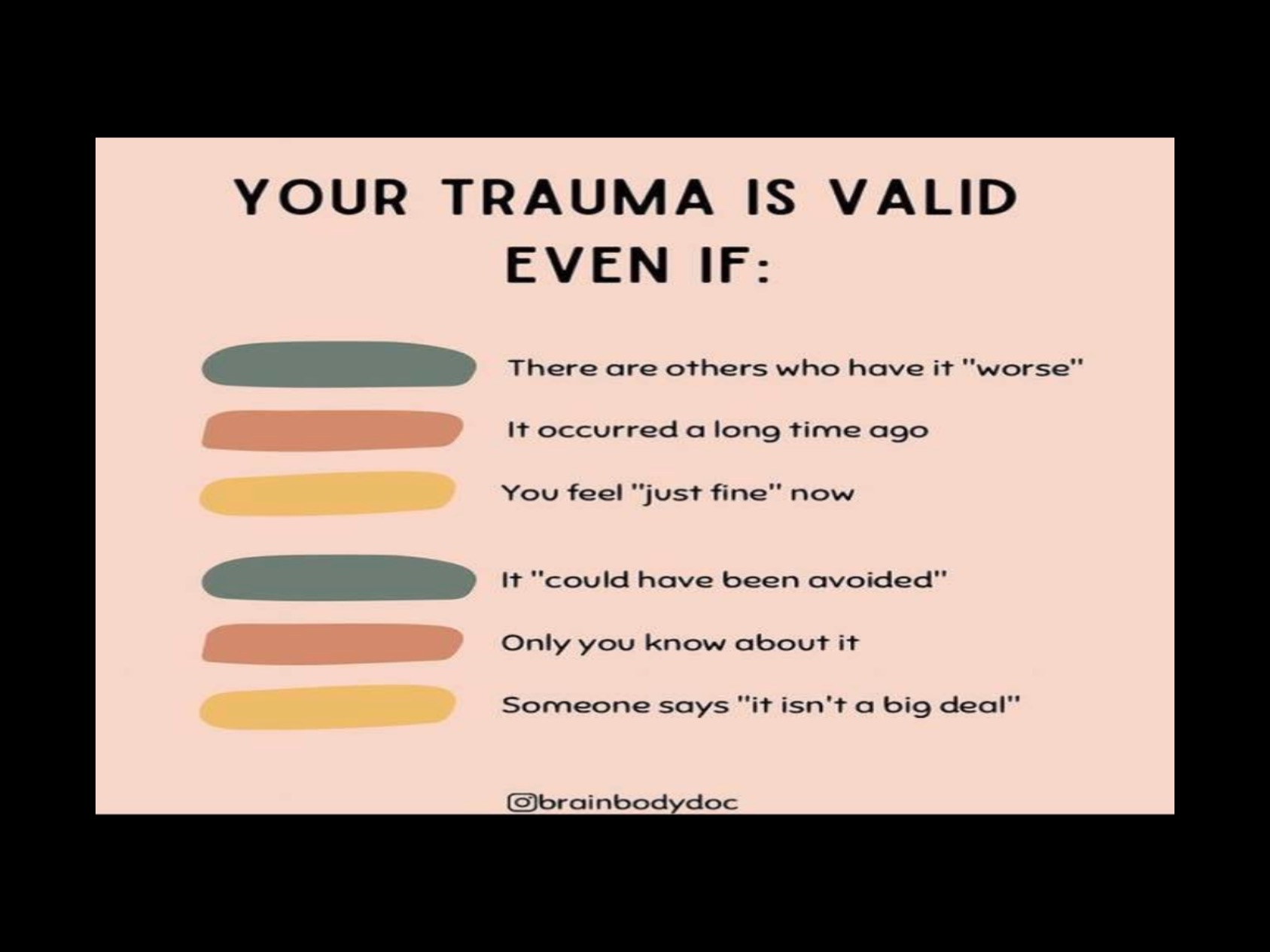
Your trauma is valid even if:

1.             There are others who have it “worse” – whilst it’s often true, this sort of belief is rarely helpful.  While it may help to focus on the fact that others do have it worse, it can tend to cut out the legitimacy of a survivor’s own unique situation and response to their trauma.  It happened.  It occurred.  And it has left its undeniable effects.

2.             It occurred a long time ago – time is an enigmatic concept when it comes to things like grief and trauma.  To try and squeeze the overwhelming concepts of grief and trauma into such a linear concept that time is, is to do our grief and trauma a definite injustice.  “Time heals all wounds” can be a dangerous generalisation, especially when we say to ourselves, “Geez, I should be over this by now!”  Sure, time can heal our wounds, but it’s an over-simplification of a very complex concept.

3.             I feel “just fine” now – again, this is the perplexing reality of mental health.  There are times in the depths when, just for a short period, we’re returned to a place of, “Wow, I feel kinda normal again,” but it’s always short-lived.  From the aspect of, “I feel ‘just fine’ now” we can easily be lulled into judging ourselves—“So then, WHY did I overreact just then???”  Actually, the ‘overreaction’ was a trauma response and it’s not helpful and it’s wrong to judge ourselves as being weak, hopeless or unworthy.

4.             It “could have been avoided” – so much hindsight comes into play, and we’re usually our worst critic when we’re in this mindset.  This is why the Substitution Test is handy.  Could someone else with the same background, age and life experience, presented with the same situation, have responded the same way?  If it’s a ‘yes’ answer, the response of “I should’ve known better” doesn’t hold up.  At times in life we see danger coming, and at others we truly don’t, or we don’t realise how bad things can get.

5.             Only you know about it – there’s always a lag between the trauma and our recognition and admission of it.  Living with trauma requires courage, but getting others involved in the narrative can be terrifying at worst and is complicated at best.  Getting others involved changes things.  But if it’s only you who knows, the cause of the trauma and its real affects are nonetheless valid.

6.             Someone says, “What you experienced/experience is no big deal” – this validates what we ourselves can come to falsely believe.  The survivor or trauma is constantly rocked between two worlds—it happened and it’s reprehensible WITH my response to this is over the top.  It’s the push-pull world of anger and guilt; the war within the self that so many survivors of trauma battle with.  This is why when someone seems to say (usually without words) that what we’ve experienced or face is ‘no big deal’ part of us expects not be believed and part of us is infuriated we’re not believed.  Whichever way you slice it, however, what you experienced is a BIG deal. You know it by how much it has cost you and how much it continues to cost.

7.             You don’t understand why – if there are two things in life that seem confounding, they’re grief and trauma.  We can sort of understand the cause—why they exist.  But what we can’t seem to reconcile is how pervasive they are in our lives.  To expect to understand why is to expect too much of the human mind and therefore the chasing of the wind.

8.             There is never any justice for the injustice suffered – whether it was a person or organisation that perpetrated violence, or it was the effect of your senses being overloaded or for any other reason, there’s the real sense that there’s never justice for the injustices of trauma suffered.  It’s a thing we’d have undone that cannot be undone, and living with the new post-trauma reality, and finding the purpose in it, is a realistic goal.  Hang on to that hope; there’s a purpose to be found.

Monday, April 19, 2021

The adversity of loneliness, the resilience of opportunity


There are so many lonely couples, busyness having eaten its way in, misaligned priorities, love gone cold, energy sapped away by the incessant demands of life, too many pressures and the inability to say no.

When I was single, I somehow forgot the loneliness that frequently visits marriage; I fell into a sober stupor of idealism that marriage is the solution to loneliness.

It isn’t.

Whenever we get married or partner up to have our loneliness solved, 
each and every time we’ll end up disappointed at best, devastated at worst.

If anything, loneliness becomes more profoundly felt when we’re partnered.  It’s because we shouldn’t feel it.  We’ve got an intimate partner to be with, who should desire us.

But what if they don’t?  What if their passion has waned and yours hasn’t?  Or, they simply don’t have your energy.  What if you face an ongoing sense of loss—an ambiguous grief for what you crave, for what’s right there in front of you, as far as potential is concerned.

It’s not the same to say, “Well, count your blessings that at least you’ve had those experiences.”  The human state is inclined to want more of what were the best experiences.

Yet, if you’re reaching out... desperate to be understood, frantic to be met, lovesick and lonely, and you even convey the words... and still there’s no response.

There’s hardly more heartache than that 
because it feels etched in betrayal—
even if it’s not a betrayal.

It happens so often.  Don’t feel you’re alone in being alone.  It’s incredibly common.

For the other, there’s the feeling that, “I don’t know what’s wrong... I don’t have the energy... I feel pushed into a corner... the more pressure you put on the less I feel I want to give you.”

Sometimes it’s about attachment styles.  Some of us are needy.  Some of us like our autonomy.  And it’s uncanny how opposites seem to attract.

Whenever we get married or partner up to have our loneliness solved, 
each and every time we’ll end up disappointed at best, devastated at worst.

And loneliness is not just about romantic relationships.  Sometimes it’s that intransigent distance between a parent and a prodigal child or a child and their prodigal parent.  For want of one human soul to come to their senses.

If you’re lonely right now, it does us well to acknowledge that we are, of a sense, cosmically alone in this life.

Job says, “Naked I came into the world, naked I will leave.”

Into life we come with nothing.  We exit life the same way.

And it seems incredible to us that this cosmic loneliness should follow us from time to time, season through season, in this life.

Within loneliness is an opportunity.  To overcome the grief of loss in such moments, once and for all.

For me, and for many of Jesus faith, it’s the presence of a God who promises nothing less than the continuous divine presence practiced by faith.

Others, too, have their own ways.  You may have yours.

I guess what I’m getting at is loneliness is an opportunity—to remain miserable or to do something about it; to bemoan it or to accept it; for it to be a cursed or blessed reality.

I’m not saying you shouldn’t be lonely.  You WILL be lonely.  I write this now because I feel lonely.  I’m in the right head and heart space to write this right now.

My opportunity right now is to face it and to feel it.
Its pain is nothing to fear.

Within every unfortunate thing is an opportunity—within conflict, betrayal, disappointment, loneliness...

When we approach an unfortunate thing and look for the opportunity, we display resilience.  It can be done, one moment at a time.  Resilience is no cliché.  It can’t be faked.

Photo by Sam Moqadam on Unsplash

Saturday, April 10, 2021

Sorrow, a therapy all its own


It sweeps in on some distant mirage
an unwanted companion
wanting to cling to the end.
It takes such a toll
you just don’t know how to roll.
You run from it, you fight it
nothing seems to work.
It lingers as a stain
that refuses to budge.
Finally, in exhaustion, with no relief in sight
no energy with which to flee or fight
you stay... still... acceptance of despair.
It’s then that you stumble on a thing.
“I cannot shift this,” you say
And then you hear,
“You’re not meant to . . .”
“WHO SAID THAT?”
S I L E N C E . . .
It captures your attention.
Caught in the vision lock-step.
“Trust,” said the Inaudible Voice, “for I am with you”
even though it seemed mad to me
I considered seriously what I was imagining
and even as I stood there transfixed
I pondered the impossible . . .
Could it be that sorrow is a therapy all its own?
. . . that bearing it wouldn’t break me?

. . . that, shudder to think, bearing the sorrow would in fact heal me . . .

“Yes, this is HOW I work,” said the Inaudible Voice.

“Let the sorrow in and feel it, and I will keep my promise.”

Photo by laura adai on Unsplash

Sunday, April 4, 2021

Commit to writing a Memoir


Remember 1999. Seems like eons ago. I was writing my “First Thirty Years” at that time having turned 30 in 1997. I’m so glad I took the time – most of that year when everyone was crazed by the ‘Y2K’ bug – and chronicled the chapters of my life until that point – the good, the bad, and especially the ugly.

I wanted it to be a memoir for my parents to read and eventually for my children too. I printed just one spiral bound copy – about 83 double-sized (A4) pages. Had my mother write the first chapter – of times for when I had no memories.

The great thing about this exercise is what I now no longer recall because of how much living the past 20 years has consumed – memories have made way for memories. But I’ve also found that the early memories are even more precious now than they were back then.

As I think about my daughters getting to an age where they might soon consider such an exercise, I think it’s a worthwhile exercise approaching that mysterious age of 30. When I turned 30, I loved it – old enough to have done some things, but still considered young. It’s amazing how our concept of age changes over time – 30 to me is just so young now.

Writing a memoir is, of course, a great idea at any time of life. All our stories are interesting, and particularly for those who follow on after us when we’re gone. Imagine the importance to our grandchildren, greatgrandchildren, and greatgreatgrandchildren. However, we lived our lives there will be immense interest, because our own lives always shed light on the lives that descend from ours. Our true ancestries are a genuine treasure for our progeny.

Another great thing about a memoir is it’s a great way to wrestle with the past. Sometimes it’s hard to go back, but we inevitably cannot go forward into joyous freedom if we continue to deny our past – we’re, of a sense, trapped in a paradigm we cannot escape from.

So here are a few little highlights from the limited photos I have around the time I was thirty, and beforehand.

My 1977 General Motors Holden Statesman V8 sounded great inside and out. The photo is taken at Radio Hill, Karratha. The periphery of the photo is as interesting to me now as the car. The place I grew up that I haven’t seen in nearly 20 years, but will thankfully return to later this year.

The bare-chested one again draws my attention to the periphery – to the books and adornments in my bedroom at the time. I must have been about 20 because there’s a whiskey bottle in the left corner. I look to the books in the bookcase, many of them I no longer have – what I’d give to walk through my bedroom now thirty-plus years on! Or to go back there to a time when three of my grandparents were still alive.

Then there’s the one of me smoking out the front with Dad. I must have been 18-19. Obviously we’re discussing the VHS video Dad has in his hands. Smoking was such a normal thing to do back then.

Blowing the candles out with family, I think I’m 34. There’s a photo of my two older daughters with two of my nieces. And finally, the photo of me with my youngest daughter at the aquarium.

The point is there could be any number of hundreds of photos in such a collection. Our memories are important. They’re worth revisiting. And in doing that there’s great healing. Once we’re healed, if there’s healing to do, then those memories become all the more precious spiritual possessions.